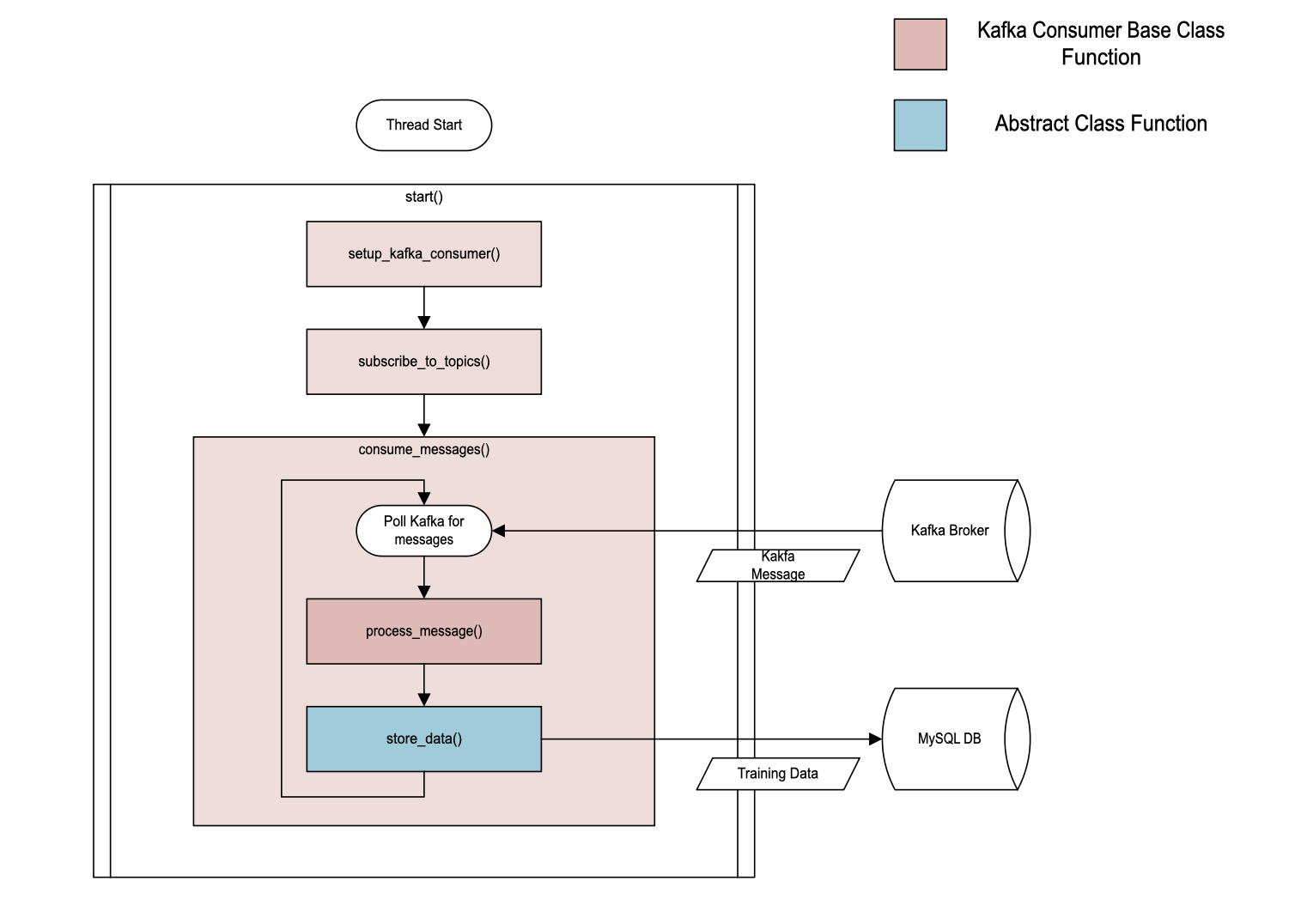
Data Ingest Thread
Core Responsibilities
The Data Ingest Thread serves as the agent's primary interface to the streaming data ecosystem. Built on KafkaConsumerBase, it maintains a persistent connection to configured Kafka topics and transforms raw streaming messages into structured database records.
Processing Pipeline
The thread operates through a continuous polling loop that retrieves message batches from Kafka. Each message undergoes parsing to extract sensor readings, timestamps, and metadata. The AutoencoderDataIngestThread implementation demonstrates this pattern by parsing JSON messages containing gymnasium environment state data, extracting numeric state values while filtering out non-numeric metadata fieldsI wou.
Data Storage Strategy
Parsed data flows into MySQL through the shared DBManager instance. The thread uses the record_sensor_data() method to store timestamped sensor readings with proper data type conversion (numpy arrays to binary blobs). This creates a persistent training dataset that accumulates over time, providing the foundation for ML model development.
Error Handling and Resilience
The thread implements robust error handling at multiple levels: JSON parsing failures are logged but don't terminate processing, database connection issues trigger retry logic, and malformed messages are skipped with appropriate warnings. This ensures that transient data quality issues don't disrupt the overall data flow.
Configuration Integration
Topic subscriptions, parsing rules, and storage parameters are all driven by the central configuration file. This allows agents to be reconfigured for different data sources without code changes, supporting the system's flexibility goals.
User Implementation Requirements
Single Required Method
def store_message(self, message, topic, partition, offset) -> bool:
    # Parse message, validate data, store to database
    # Return True for success, False for failure
Implementation Steps
- Parse Message: Decode bytes to string, parse JSON/format
- Extract Data: Pull relevant fields (timestamps, sensor values, metadata)
- Validate: Check data types, handle missing fields, filter invalid data
- Transform: Convert to database schema format (arrays to numpy, timestamps to datetime)
- Store: Call
self.db_manager.record_sensor_data(data_dict) - Return Status:
Trueif successful,Falseif failed
Configuration Needed
config = {
    'kafka_topics': {'input': 'your-topic-name'}
}
Environment Variables Required
KAFKA_BROKER_URLMYSQL_HOST,MYSQL_PORT,MYSQL_USER,MYSQL_ROOT_PASSWORD,MYSQL_DATABASE
What's Handled Automatically
- Kafka consumer setup/teardown
- Topic subscription and polling
- Database connection management
- Thread lifecycle and health monitoring
- Error recovery and restart logic
- Message batching and offset management
Key Constraints
- Single-threaded: Keep
store_message()fast and efficient - Error handling: Catch exceptions, log errors, return
Falsefor failures - Database schema: Match expected format for
record_sensor_data() - Memory management: Don't accumulate state between messages
The base classes handle all infrastructure complexity - users only implement domain-specific data transformation logic.
Architectual Loop Diagram